
Clinton County Court Records After Arrest
The Clinton County jail roster tells why the jail is holding someone. Court records after a jail arrest answer a different question: what charge the Clinton County Attorney filed in Iowa District Court. The roster may list a charge code, a bond type, an arrest date, and the phrase "Set By Judge," but those entries are booking and hold data. Formal court records live with the Iowa Judicial Branch and Iowa Courts Online once a criminal case is opened.
The local prosecutor is the Clinton County Attorney's Office, not a district attorney office. The county page lists Mike Wolf as County Attorney, with the office at the Clinton County Courthouse, 612 N. 2nd St., Clinton, IA 52733. For custody and booking detail, use Clinton County jail inmate records. For booking photos, use Clinton County jail mugshots. Court records after an arrest should be checked in the court system because filed charges can differ from the jail's first hold text.
Search Clinton County Court Records
The main public case-search channel is Iowa Courts Online. The Iowa Judicial Branch also routes public users through its Search Court Records page. Public docket data can include case titles and filings, party and lawyer names, criminal charges, disposition entries, fines and fees owed, and fine or fee payments. Public case documents are more limited. Some documents may require a courthouse public access terminal or a paid subscription.
The official Iowa Courts Online entry point for case searches is shown in the Iowa Courts Online portal.
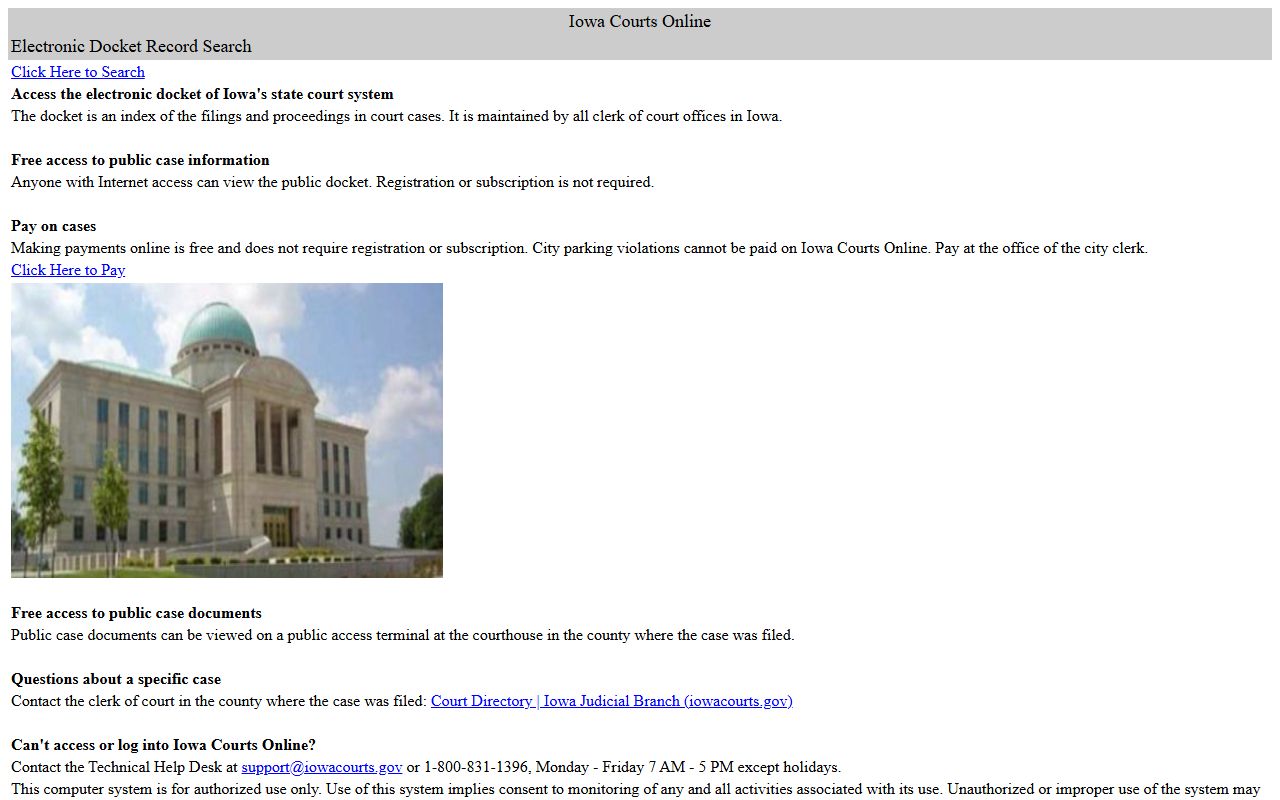
Use the court portal for filed cases, not as a live jail roster. The Clinton County roster can help identify the arrest date, held-for agency, and booking charge text before the court search begins.
- Open Iowa Courts Online and search by defendant name or case number.
- Select Clinton County when a county filter is available.
- Use the arrest date from the jail roster to narrow recent results.
- Open the case link and review the charge list, docket entries, attorneys, hearings, disposition, and fines or fees.
- If the case is too new to appear, try again later or contact the Clerk of Court through the Iowa Judicial Branch Clinton County District Court page.
| Field | Use | Notes |
|---|---|---|
| Case ID / Case Number | Exact case lookup | Best when listed on a notice, citation, or complaint. |
| Party / Defendant Name | Name search | Spelling and middle names can affect results. |
| County | Local filter | Choose Clinton County for local district court cases. |
| Case Type | Criminal filter | Use criminal case options for filed charges after arrest. |
| Filed Date | Date range | Helpful when the arrest is recent and common names return many cases. |
Clinton County Arrest Charges
After a Clinton County arrest, the jail intake record can appear before the formal court record. Police or sheriff staff book the person into Clinton County Jail. A prosecutor then reviews reports and decides what charge to file. The County Attorney may file the same charge shown by the roster, change it, add counts, reduce it, dismiss it, or file separate cases when more than one event or warrant is involved.
| Complaint | Trial Information | Indictment | |
|---|---|---|---|
| Filed By | Officer or prosecutor | County Attorney | Grand jury process |
| Common Use | Starts many criminal matters | Common felony charging route in Iowa | Less common, used when grand jury charging applies |
| Record Location | Court docket | Court docket | Court docket |
| Reader Caution | May change after review | May replace earlier complaint detail | May not match booking words exactly |
Roster language should not be treated as the final court charge. In sampled Clinton County public roster data, hold reasons included Iowa Code references, descriptions, arrest dates, bond types, and bond amounts when set. That is useful intake detail, but the court docket controls the filed case and the disposition.
Clinton County Charge Status
Charge status can change several times after a jail arrest. A pending charge has not reached final disposition. A filed charge has been opened in court. An amended or reduced charge means the filed allegation changed after review, plea talks, motion practice, or another court action. A dismissed charge ended without a conviction on that count. A conviction follows a plea or verdict. Iowa can also use deferred judgment, which may not count as a conviction after successful discharge but still needs careful review in the docket and any DCI criminal-history record.
| Status | Meaning |
|---|---|
| Pending | The charge or case is still open and has no final outcome. |
| Filed | The prosecutor opened the formal court charge. |
| Amended / Reduced | The charge was changed or lowered from an earlier version. |
| Dismissed | The charge ended without a conviction on that count. |
| Convicted | The court entered a conviction after plea or verdict. |
| Deferred Judgment | An Iowa disposition that can have special later effects if conditions are met. |
Bond After Clinton County Arrest
Clinton County roster hold reasons can show bond terms such as Cash Only, Cash/Surety, Cash / Multiple Cases, or No Bond. Some entries include an amount and "Set By Judge." Bond shown in a roster row should still be verified with the jail or court before money is sent or anyone travels. A judge may change bond, add conditions, or keep a person held because of another agency's case.
| Bond Type | How It Works |
|---|---|
| Cash Only | Cash is required under the court's terms unless the order changes. |
| Cash/Surety | Cash or an approved surety path may satisfy the bond if accepted. |
| Cash / Multiple Cases | The bond may apply across more than one case, so every case must be checked. |
| No Bond | Payment will not release the person at that point. |
The Clinton County inmate money page allows inmate funds to be released for the inmate's own bond, own fines, attorney fees, commissary supplies, and work-release payments. That money rule is separate from the court's bond order. Call Clinton County Jail at 563-242-9211 to verify current bond, all holds, and the accepted payment path.
Clinton County Warrant Arrests
A warrant can turn a court case into a jail booking. Clinton County's CentralSquare portal code includes warrant-related request fields, including name, race, sex, date of birth, date issued, bond amount, and charge. Research did not confirm a working public active-warrant list on the county site, and the sheriff navigation reviewed did not show a standalone active warrants page. Avoid relying on an unverified public warrant search for Clinton County.
For warrant concerns, call the Sheriff's Office or Records Division at 563-242-9211, or check Iowa Courts Online for bench warrants tied to a court case. In-person contact is at the Law Center, 241 Seventh Avenue North, Clinton, IA 52732, during business hours, with electronic devices left outside due to the Law Center device rule. A warrant from another county, a probation hold, a DOC hold, or a federal hold can keep someone in custody even when a local Clinton County bond appears payable.
Charges Versus Convictions
An arrest and a charge are not the same as a conviction. A jail arrest is the custody event. A charge is an accusation filed or carried in court. A conviction requires a plea, verdict, or qualifying court judgment. Public court records after an arrest can show each stage, but the reader must not treat the first roster charge as the final outcome.
| Charge | Conviction | |
|---|---|---|
| Stage | Accusation after arrest or filing | Final court finding after plea or verdict |
| Proof Level | Probable cause or formal filing threshold | Beyond a reasonable doubt or admitted by plea |
| Where Seen | Jail roster and court docket | Court disposition and criminal-history records |
Sealed Arrest Court Records
Iowa public records law is broad, but it has limits. Iowa Code Chapter 22 generally gives access to public records unless another law makes the record confidential. Iowa Code section 22.7 includes law-enforcement confidentiality exceptions while also treating current and prior arrests and criminal-history data as public in the statute text. Juvenile, sealed, confidential, medical, investigative, and court-restricted information may not appear online.
| Sealed or Confidential | Expunged | |
|---|---|---|
| Public Access | Hidden or restricted from ordinary public search. | Removed or restricted under a court-approved record-clearing process. |
| Agency Access | Some official access may remain. | Access depends on the expungement statute and order. |
| Common Path | Court rule, juvenile law, confidentiality law, or court order. | Eligibility and petition process through the court. |
Iowa Criminal History Checks
A court-record lookup is not the same as a statewide criminal-history check. Iowa.gov directs criminal-history background checks through the Iowa Division of Criminal Investigation. The DCI product costs $15, and online or in-person methods are available. Walk-in DCI processing hours are Monday through Friday, 8:00 a.m. to 4:00 p.m.; own-background-check requests with state-issued photo ID may receive immediate results, while other requests may take two to five business days.
Important: Clinton County Inmate Population is not a consumer reporting agency under the Fair Credit Reporting Act and may not be used for FCRA-covered screening.